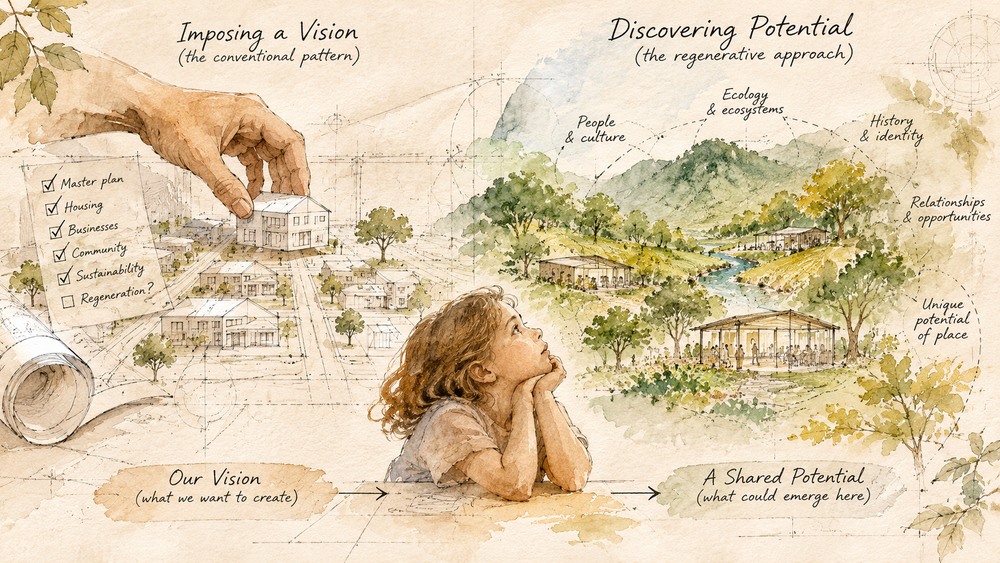




One of the greatest contradictions I encounter in developments that aspire to be regenerative is that we want to transform our relationship with life without transforming our relationship with money.
We acquire land, promise financial returns, establish deadlines and commit to a development vision before understanding the unique potential of the place.
From that moment, our freedom to discover begins to shrink.
We may encounter extraordinary opportunities, but if they don’t fit our financial projections, we dismiss them. We may discover that the land requires something different, but we have already made commitments. We may recognize that our original vision needs to evolve, but changing direction becomes a financial risk.
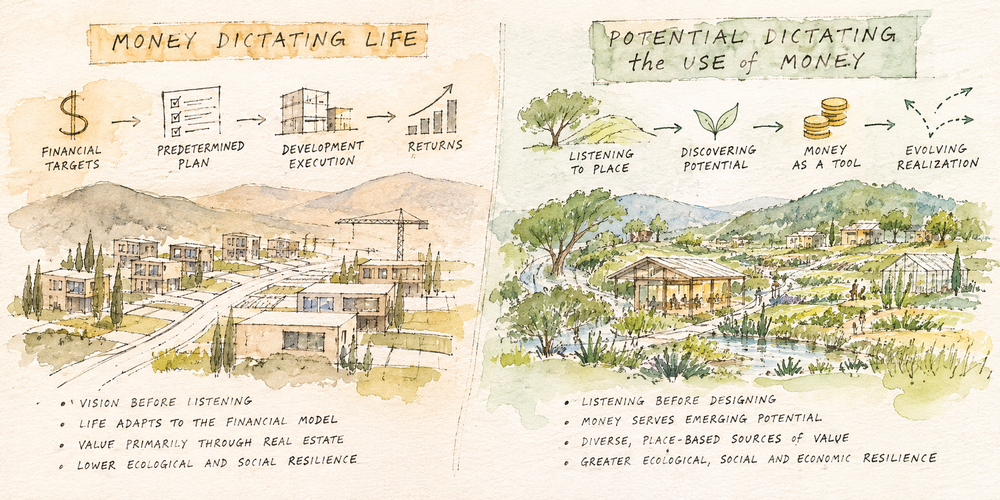
And so, despite our regenerative intentions, we begin asking life to adapt to our financial model.
We cannot expect regenerative outcomes from financial structures that systematically reward conventional behavior.
Financial constraints or self-imposed limitations?
Needing to raise a million dollars is a financial constraint. Deciding that we must sell twenty homes to raise it is a strategic choice.
Yet we frequently confuse the two.
Once we become attached to a particular solution, we stop looking for other possibilities. We direct our intelligence toward making our plan work rather than discovering what else could work.
What economic opportunities might emerge if we genuinely understood the ecological, cultural, social and productive potential of a place?
Could we generate wealth in ways that strengthen the larger living system rather than primarily monetizing the land?
What if money served potential?
This is not an invitation to abandon profitability, ignore financial commitments or romanticize regeneration.
It is an invitation to innovate.
What if investors invested in the realization of potential rather than exclusively in predetermined products?
What if financial agreements rewarded our capacity to learn, adapt and discover new sources of value?
What if financial constraints became conditions for creativity rather than justifications for compromising our regenerative principles?
Openness, patience and trust are not necessarily the opposite of economic intelligence. They can be conditions for recognizing opportunities that our original projections could never have anticipated.
Redefining wealth
Perhaps the deeper question is not how much wealth we can generate from a place, but how much wealth we can generate with it.
Wealth expressed through healthy ecosystems, thriving local economies, meaningful relationships, human capabilities and financially viable enterprises.
Wealth that increases the capacity of the whole system to generate more wealth.
Money can play an extraordinary role in this process. But we need to reconsider its position within our hierarchy of intentions.
Are we developing the potential of life with the support of money, or directing the potential of life to satisfy the demands of money?
The difference changes everything.